铜仁2026年摩托车科目四英文题库345题
1、When parking temporarily on a snowy day, drivers should turn on the headlamp and fog lamp.
A. Right
B. Wrong
Answer:B
2、A light motorcycle is only permitted to carry preschoolers.
A. Right
B. Wrong
Answer:B
3、How should lamps be used by the motor vehicle driver who follows a vehicle on a road section at night where he street light condition is good?
A. Turn off the headlamp
B. Use high-beam
C. Turn off all lamps
D. Use low-beam
Answer:D
4、When a motor vehicle passes over an overflowing bridge, what should the driver do after stopping and observing closely?
A. Change to a high gear and pass rapidly
B. Constantly observe the changes of the flow
C. Prepare to stop at any time
D. Change to a low gear and pass through at a constant speed
Answer:D
5、Which one of the following measures is correct when a motor vehicle intends to overtake but the vehicle infront refuses to yield?
A. Use a long-sounding horn
B. Follow the vehicle in front while turning high-beam
C. Wait for it to yield while keeping a safe distance
D. Use high-beam and low-beam alternatively
Answer:C
6、Which lamp should be used when motor vehicles pass hrough an intersection at night where there is no traffic light signal?
A. High-beam
B. Low-beam
C. Hazard lamps
D. High-beam and low-beam should be used alternatively
Answer:D
7、vehicles to pass an intersection marked with this sign?
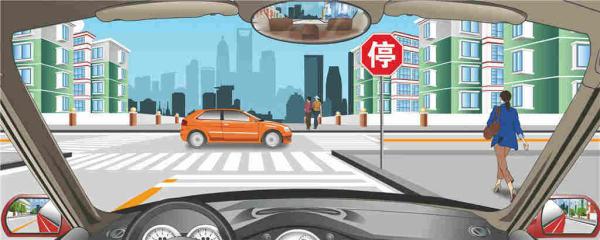
A. Stopping and observing the traffic situation around the intersection
B. Approaching the intersection by speeding up
C. Approaching the intersection at a reduced speed
D. Observing the traffic situation on the left rear side
Answer:A
8、What should be done by the driver who intends to overtake but finds that the vehicle in front is also overtaking?
A. Following the vehicle in front closely and finding a chance to overtake it
B. Accelerating to overtake forcefully
C. Continuously sounding the horn to urge the vehicle in front to yield
D. Refraining from overtaking and letting the vehicle in front overtake first
Answer:D
9、When a motorcycle reaches a muddy or burst-and-muddy section, the driver should stop, observe and select the level and solid section or the section with vehicle tracks.
A. Right
B. Wrong
Answer:A
10、When a wounded person suffering bone fracture in the thigh, shank and spine, it is necessary to keep the fracture in position and refrain to move the wounded person.
A. Right
B. Wrong
Answer:A
11、What are the main reason for not applying emergency braking when driving on rainy days?
A. Increase fuel consumption
B. Reduce fuel consumption
C. The tires can easily spin
D. Easy to cause rear-end collision
Answer:CD
12、Speeding up to go though the intersection before the light turns to red in this case.

A. Right
B. Wrong
Answer:B
13、The wrong method about parking is to _______.
A. Parking on a railway crossing
B. Parking on a level crossing
C. Parking on a parking lot
D. Parking on rocky sections in Mountainous Areas
Answer:ABD
14、When the vehicles cross each other at night, what should the driver do if the vehicle coming in the opposite direction always use the high beam light.
A. Continuous change lights and honk to remind the vehicle coming in the opposite direction
B. Turn on the high beam light
C. Reduce speed or driving on the right side.
D. Move his sight to the right side to evade the light
Answer:CD
15、What is the meaning of this sign?

A. Road narrows on both sides
B. Road narrows on the right side
C. Road narrows on the left side
D. Bridge narrows
Answer:A
16、When an erosive material catches fire, it should not be put out with water cannon.
A. Right
B. Wrong
Answer:A
17、What should the driver do to follow other motor vehicles on a mountain road?
A. Closely follow the vehicle in front
B. Increase the safety distance
C. Reduce the vertical distance between vehicles
D. Try to overtake the vehicle in front as soon as possible
Answer:B
18、What is the meaning of this sign?

A. No entry for bicycles
B. Lane for non-motorized vehicles
C. Special lane for bicycles
D. Bicycle stopping area
Answer:B
19、A correct measure to avoid tire burst of motor vehicles is to lower the tire pressure.
A. Right
B. Wrong
Answer:B
20、What is the meaning of this sign?

A. No changing lane
B. No left turn
C. No going straight
D. No U turn
Answer:D